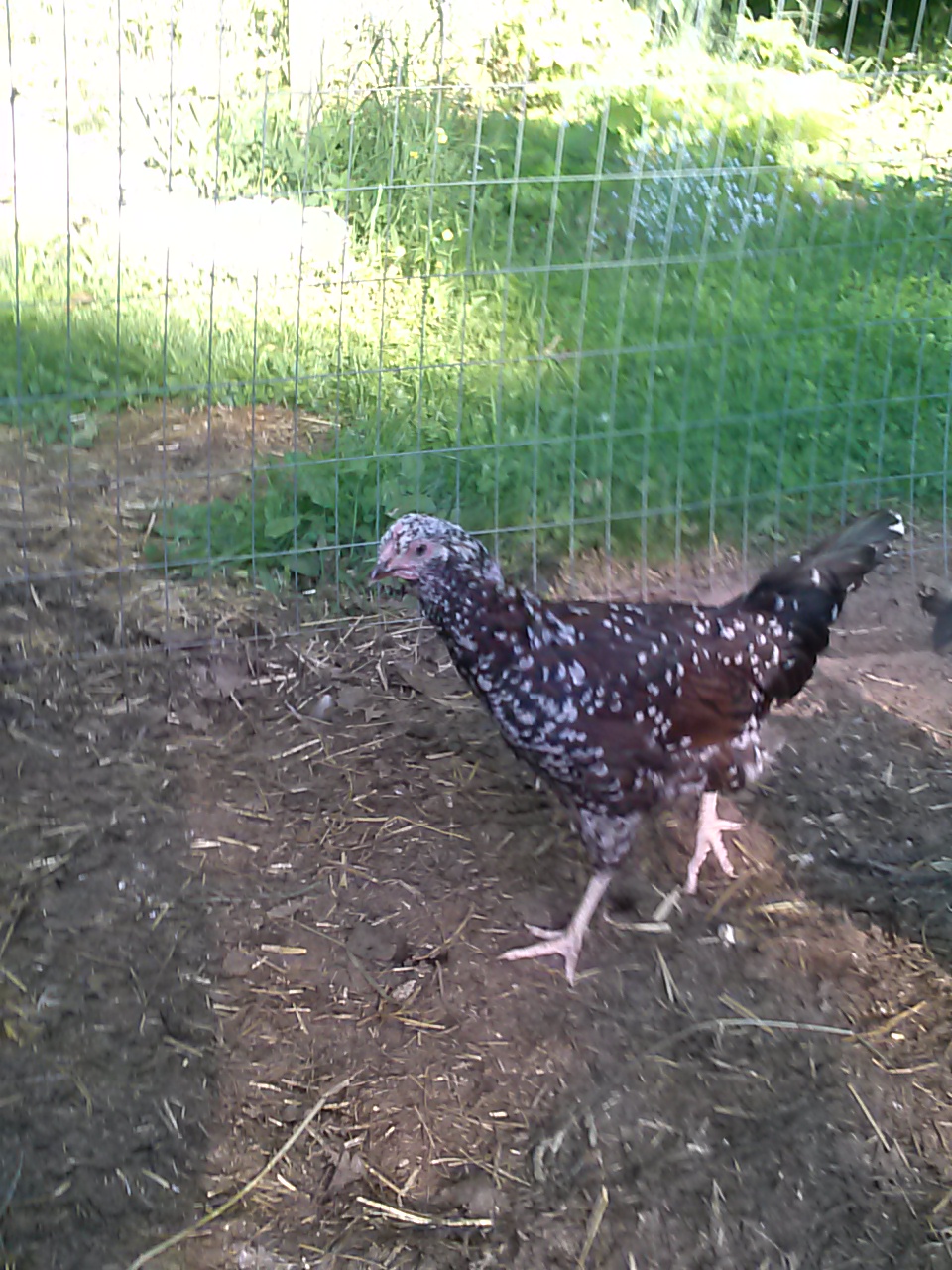
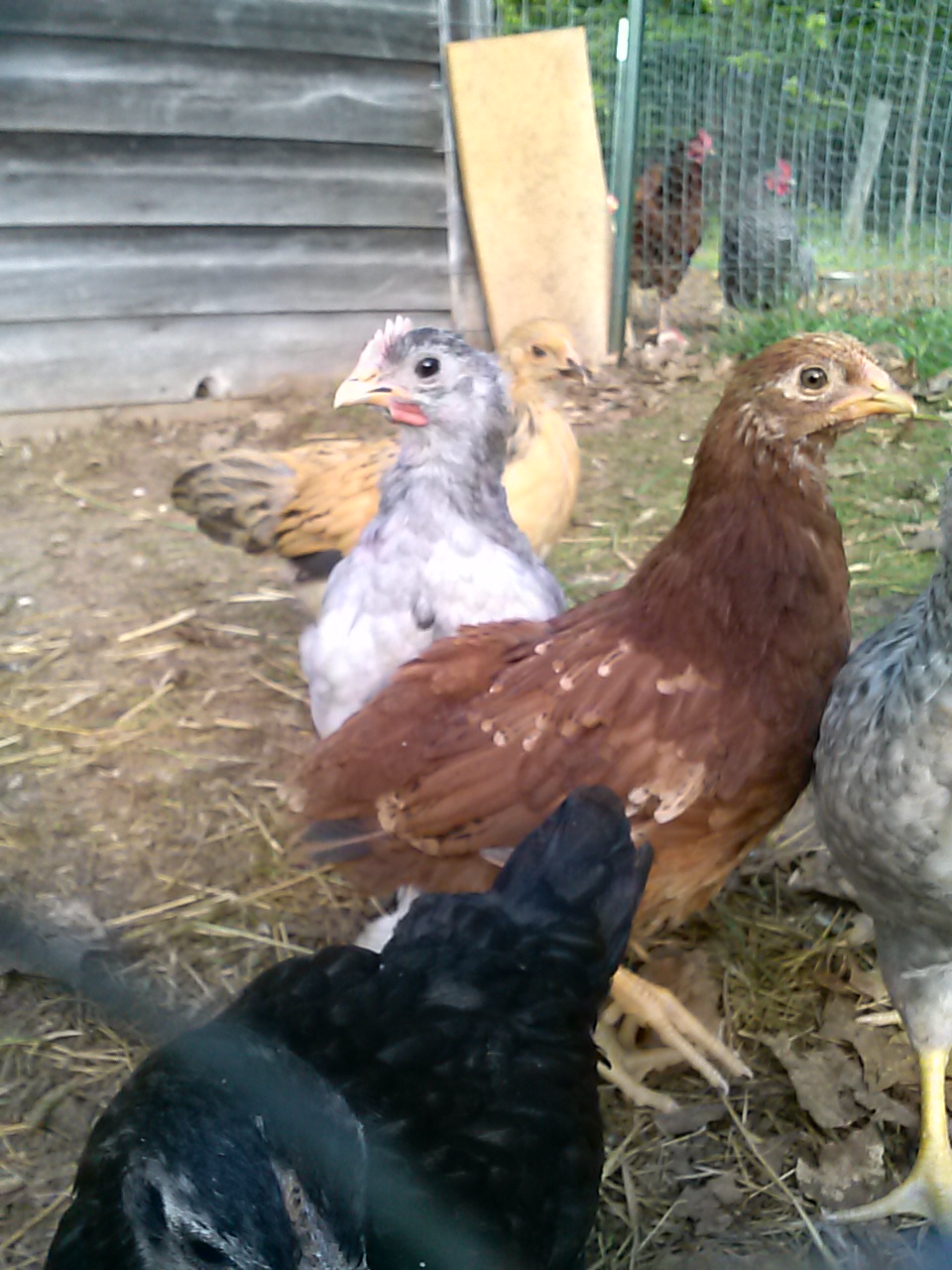
My six “teenage” chickens are just over 3 months old now. I’m still working on figuring out the sex of each of them. I read that at 3 months you can start to tell by the saddle feathers whether they are male or female – males should have pointed / longer saddle feathers, and hens should have rounded ones. (Saddle feathers come down the sides in front of their tail feathers). It would probably be easier to tell if my chickens were all the same breed, but they are not. That complicates things quite a bit. For awhile I thought I had 5 roosters and a hen. But there are two that seem to have rounded saddle feathers, and they aren’t that long. But one of those crowed at me awhile back (which I’ve heard is actually not a very reliable indicator – hens can crow too). And like I said, they are all different kinds of chickens. Here are some updated pictures of my teenagers. (Sorry for the quality of some of these).
Here is my one definite rooster. He has the fancy tail, and has been crowing since 2-3 weeks old. He’s starting to sound like a real rooster now. We think he may be a Black Langshan.Here is my Speckled Sussex. I believe she is a hen, she is smaller than everyone else. But she also is the only Speckled Sussex I have so I can’t be sure. She looks like a hen to me. She’s usually very tame and lets me hold her.Here they are together. These two hang out a lot together.Here is my Buff Brahma. I’m pretty sure he’s a rooster.Here are my Red (still don’t know what kind ) and my possible Wyandotte. I think the Red may be a hen, but this is the one who crowed at me once. Her / his saddle feathers are short and rounded though. I believe the black and white guy is a rooster, and possibly another Silver Laced Wyandotte like my old Rooster was – the markings are a bit different but the coloring is the same, and I found out the rare breeds I ordered can include Wyandottes.Here are my Brahma, the Wyandotte, and my possible Delaware (the white one with black speckles). I am not sure if the Delaware is a rooster or hen – can’t quite tell. Roundish saddle feathers but pointy neck feathers, which is another feature of roosters.
On another note, we haven’t been getting that many eggs lately – we went from about 6-8 a day to 3-4 a day on most days. I figured it’s been stress from the combining of chicken groups. Last week I found one of my white adult hens was getting broody – every time we go in the coop, she’s laying in the same nest box. At first I thought “oh, cool!” and figured she could raise some chicks if she gets them to hatch. Then I realized that we haven’t had an adult rooster in a few weeks, so those eggs are not fertile. A day or two after I realized that, she got up and I found a few eggs under her, so I took them out, and tossed them since they may have not been very fresh. (When in doubt I toss them rather than risk it).
I hadn’t looked under her all this week, since each time I go to try to move her she pecks at me. I keep forgetting to bring gloves into the coop. I figured she probably had a couple eggs under there, so I would just wait for her to get up and toss them – well, today, I was in there taking pictures for this post and saw that she had gotten up. I went to check the nest box and she had TWELVE eggs under her! That is at least part of the reason we have not been getting so many eggs. She’s been in one of the ladies’ favorite nest boxes, so I bet that when she gets up to eat, they go in and lay an egg, and then she sits on them. I’m going to toss a pair of gloves into the coop, in my supply bin that the chickens can’t get into, and then I can check daily for eggs if she stays broody.
I put some of my chickens to work today. My garden is just sitting, waiting for me to start planting this coming weekend when I have time. I want to get all the plants in at once. I decided to put a few chickens in there today, to scratch around and get any bugs out, and also to eat some of the grass that is at the fence line.
Here are a couple chickens scratching in the garden.
I chose to use some of my adult hens because I figured they may be more efficient, and also I didn’t want to cause any kind of anxiety issues with the teenager chickens. I thought that taking them out and then putting them back in the coop later may cause them unneeded anxiety, but that my adults would be able to handle it since they’re top of the pecking order. We put four hens in the garden in the morning before I left for work, with a little shelter made out of large flower pots and a piece of wood, in case they needed to get out of the sun.
Chickens in the garden – the little bowl here is for water for them.
My ladies did a good job – my garden seemed quite picked over; I could tell that they had scratched most of it up. I had made a pushed-down “trail” going through the middle, which will be my pathway, and that was completely gone by the time I got home. I could tell the grass at the fence line was a lot smaller as well.
The garden space is right next to our dog run. At first the hens were very scared when Atat ran out to see what they were doing. Downey was interested but not as playful as Atat. Atat ran up and started running up and down the fence line, and the chickens ran away back and forth from him, and then finally bundled up in the corner for awhile, till he went back inside.
Atat checking out the chickens.
My husband said it got better later during the day – when the dogs would come out they would just quietly watch the chickens pecking around in the dirt. The chickens relaxed a little when they figured out the dogs couldn’t get to them.
When I got home from work I put the ladies back in their own coop/run. I noticed that the pecking order in the coop was a little different before the hens were put back. Moving four hens to the garden gave the teenagers an advantage against the hens. Six teens to five hens – my teenagers seem a little more aggressive, which I take as a positive sign; they’ve been so scared of the hens until now – I saw one of my teens run up and peck a hen, instead of cowering when she walked by, which is what they usually do. The pecking order will shift a bit for awhile I bet, until they all get used to each other and figure out their places. That will probably be just in time for me to introduce the babies into the flock.
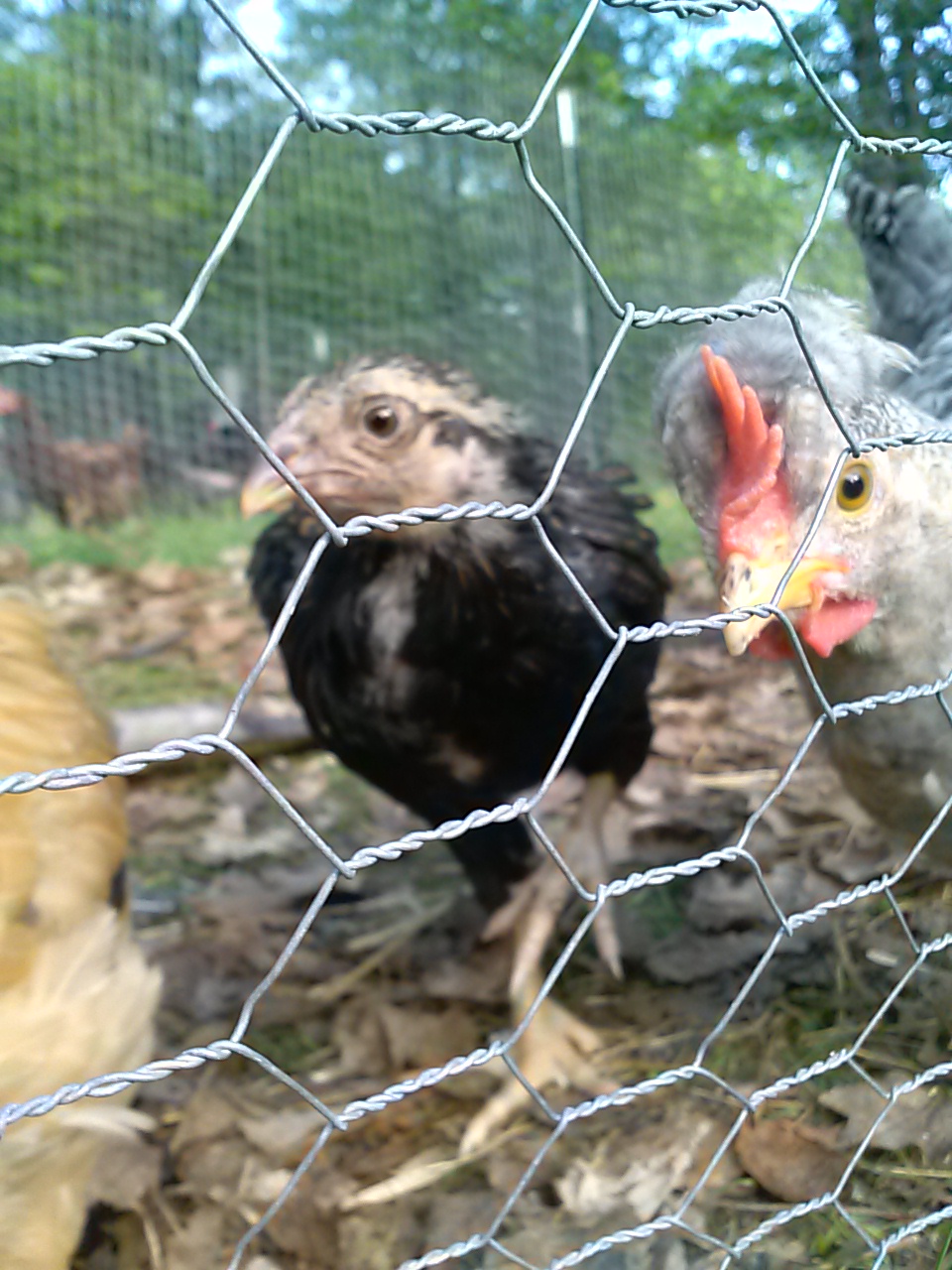
I meant to do an update on my smallest batch of chicks, showing how each one changed from one week to now; but I moved them outside before I could do that update. I don’t want to traumatize them by catching them all – it’s harder to do once they are out in the coop. I went to their coop with my camera and they were very curious; I think they were hopeful that I had some treats for them. Here are some cool pictures of the babies – they are now 6 weeks old.
Here you can see one of the Buff Brahmas on the left (we have two this batch) along with a red chick and our little rooster who has a strange puff of feathers behind his comb – this little rooster started crowing in the last week.Here’s our Black Sumatra (I believe that’s what he/she is – this is the escape artist) along with a gray/white chick (the dorking, I think) and the rooster.Here are my two small Buff Brahmas. I called these two “the twins” in the first photo shoot of them back in late April.Here’s my Sumatra (in front), the dorking, and the red chick.Here’s my brown speckled chick. He / she is a little more shy than some of the others. The rooster apparently likes to be in pictures, so he’s here too.The whitish/grayish chick is a White Brahma, I believe. She has feathered legs like the other Brahmas. And the rooster is here too.My white Brahma and my red chick, and a Brahma behind them.
They are getting big. I’m a little more able to tell what kind they are. A few of them I’m still not so sure (even with the “teenager” chicks I still have no idea, and they are pretty much adults).
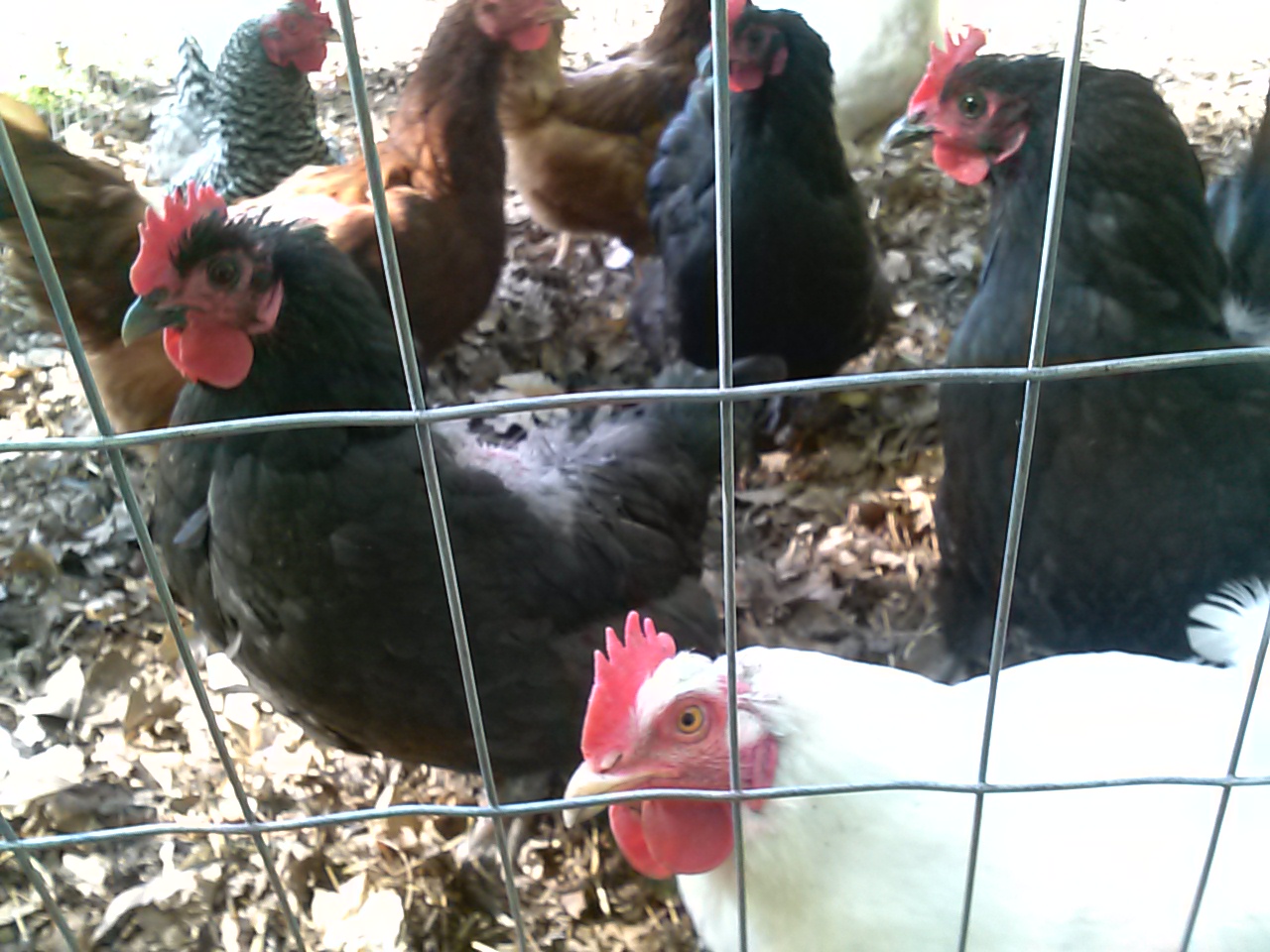
As you can see in some of the pictures above, my adult ladies were watching the photo shoot, wondering if I had any treats for them as well. Here they are:
Here are my adult hens.
My “teen” chicks were inside the coop eating instead of watching the photo shoot, so I didn’t get pictures of them today. They have been getting along better with the adults, but they still keep to themselves as a group instead of mingling with the adult hens.
* WARNING – if you are a vegetarian, you may want to skip this post.
My Silver Laced Wyandotte Rooster
My beautiful rooster got to be a problem – he would not leave my hens alone, he was constantly mounting them. Every one of them has a bare back right now – my white hens still have most of their feathers on their backs, but they always had dirty backs from his feet, and they were losing feathers on their heads. At first I hoped they were molting, but I eventually realized this was not the case, based on where they were losing feathers. I didn’t want to just separate the rooster from the hens, because I didn’t have a separate place to put him. I also know that several of my older chicks are roosters as well, so I will have to figure out who gets to stay/who has to go at some point anyway. This weekend, after spotting more bald spots on a particular hen’s head, I decided it was time for him to go.
I culled him with a quick chop, and butchered and cooked him, all by myself. Here are some things I learned:
1. Always read up on how to do things beforehand. Don’t just rely on stories people tell you, “well, Grandma used to do this…” I did not do research beforehand. I just went ahead and gave it a try. I was not sure how to make certain cuts when butchering. I also didn’t realize how hard some of those feathers would be to get out. I didn’t end up scalding him, so the wing feathers and pin feathers were extremely hard to pluck. I ended up cutting the wings off because I didn’t know what to do to get those feathers out.
2. Always let the meat rest in the fridge for a day before cooking or freezing. In the middle of roasting, I decided I should look up online how to butcher a chicken properly, for next time. That is where I learned that if you try to cook it right away, rigor mortis sets in and you will end up with a very chewy bird. We ended up with a very chewy bird. A day’s rest will let the rigor pass and the meat get soft again.
3. Do not overcook. I roasted it at too high of a temperature, and cooked for too long. This, along with the rigor, made our chicken very hard to chew at first. I do know how to cook a chicken, but I usually underestimate how long it will take when meal planning, and have to add time on, and we end up eating the side dishes while the meat is still cooking because it’s taking too long. So I went overboard on the cooking, and it showed.
4. Always have someone around that is an adult. My six year old son was there, and he didn’t like the rooster so he was happy to watch – the rooster was a little threatening to him most of the time. Daniel attempted to help me pluck feathers, for a minute, and then went back to playing. Then the neighbor kids showed up, while I was in the middle of plucking and butchering, and Daniel wanted them to all go inside. Our dogs are not the friendliest (well, Atat is, but Downey is not usually) and I yelled at Daniel to make sure they all stayed outside since I was arm deep in trying to butcher a chicken without really knowing what I was doing, and had no time to try to get the dogs out of the way. My husband was at work; I should have waited for him to get home before attempting all this on my own.
5. Always have all your stuff (knives, bags, towels, etc) ready beforehand. Nothing is worse than needing to make a cut in your chicken, and you somehow got dirt on your knife, and need to run to get a clean one, but don’t want to leave the chicken outside where the flies are already waiting to dig in. Also, always make sure your kitchen is clean so that you don’t have to attempt to butcher the chicken outside.
I muddled through, and did ok. The meat tasted really good, although I did have to put it in the crockpot on low the next day so that it was a lot more tender and we could actually eat it. I also realized why dark meat is called “dark meat” and white meat is called “white meat” – it was more pronounced on this bird than on regular store-bought chicken. I don’t know if it’s like that with all home-raised chickens, or the fact that he was almost a year old, or if it was just the breed. Silver Laced Wyandottes aren’t typically a meat bird, as far as I know.
Now that I’ve done it, and done the research afterward on what I should have done the first time, I think I’m ready for when the next time comes. As I said, I know that several of my chicks are probably roosters. Of my six older chicks (the “teenagers” as my son calls them), I’m 99% sure that 5 of them are roos. I don’t know how many of the eight little chicks are roosters yet. I can’t keep them all – we’ll have to decide who to keep and who gets eaten when they are older.
My art-room / spare bedroom has been a chick brooder since January of this year. The weather is warmer and I’ve decided I’ve had enough – my smallest chicks (one month old) have most of their feathers, and it’s been getting warmer lately. I wouldn’t be in such a rush but the escape artist has taught the others to escape – I’ve changed them to 3 different brooder boxes, each one taller, and they keep getting out and pooping everywhere. I’ve been thinking about ways to get them outside permanently.
I’ve had my older chicks (2.5 months old) outside for about a month, but separated from my adult chickens. They could see and hear each other, but not interact. We decided to try to integrate them, in order to bring the smaller chicks outside – I planned on putting the big chicks with the adults, and then putting the babies in the separate part that the older chicks had been in. I’ve heard to try to do it at bedtime, so they don’t really realize what’s going on, in order to keep the transition smoother. We did not do this for some reason. A few hours before I put them in for the night, we put the six 2.5 month olds in with the ten adults. They are very nearly the same size.
It was a mess. My poor chicks were traumatized. I figured my rooster would be the main culprit, but my hens were really mean. I know that they need to work out their pecking order, and it can take some time. First it was like two cliques – adult birds on one end of the run, the chicks on the other. Then somehow a couple chicks got separated and my hens started chasing them and trying to mount them, I guess. Then the chicks were in two groups of three. I went inside for a few minutes to let them work it out. I came back out and heard loud squawking. I found one of the chicks cowering in a corner of the run, trying to get back into their old run. It ended up with the chicks hiding inside a corner of the coop, and all the adults hanging out in the run. I was going to just let them sort it out, but I felt really bad. My chicks were really scared – one even kept losing feathers – I don’t know if it was from stress or from being pecked by the hens. I figured we will have to integrate them eventually, and they’ll work it out.
Then I brought the small one month old chicks out to the newly empty temporary coop/run. They were very happy out in the run. I wondered how they would get on with the older chicks, and if it would be better to integrate THEM right now, and then put all the chicks in with the adults later once everyone is the same size. I tried bringing the older chicks back in, one by one, and putting them out in the run with the tiny chicks
It seemed to go a lot better. The 2.5 month olds are quite a bit bigger than the 1 month old chicks, and they have been picking on them a bit, but they’re not obsessed with them like the adults seemed to be with the older chicks. If the small chicks stay away from the older ones, they don’t get pecked at all. The small chicks don’t seem too stressed, anyway.
My big chicks and large chicks together.Another picture of them together.
I had a couple of issues when putting them in for the night though – first, the little chicks had no idea what was going on. I have to get them trained to go in at night (usually I clap and follow the chickens in, the older ones have learned this pretty well) – so they didn’t go into the coop on their own when I did this. I picked them up, put them inside, and then a couple of them ran outside but their run was open so they ran into the yard. I had to catch them – that wasn’t too hard.
My biggest issue when putting them to bed was that the older chicks were hanging out right under the heat lamp, which was in the corner of the coop. The baby chicks found a nice spot on a pile of hay that they liked, since it was far away from the older chicks, but that wasn’t close to the heat lamp, and I worry about it getting cold at night if they can’t access the lamp. My husband was smart and just moved the heat lamp to the middle of the room for me – so that problem got solved. I also gave the babies some straw to go on their hay pile, because hay is NOT very soft, at least compared to straw. I put the water and food a bit more in the middle, so that the babies wouldn’t have to go too near to the older chicks to eat or drink, and risk getting picked on. We checked on them through the night before we went to bed, and they were doing ok.
This morning I went out, and the poor little babies were huddled in their corner. It got into the 30s last night, and while the heat lamp makes the inside of the coop quite a bit warmer than the outside temps, they were still pretty cold. They were doing ok, but the big chicks kept going over to them and pecking them, just in the time I was out there this morning to let them all out. The big chicks were also hanging out under the heat lamp in the middle, so the little guys couldn’t go over to the heat light, or the food and water without getting pecked. So I got fed up, and stuck the big chicks in with the adults again, and said “you are all just going to have to figure it out. ”
The babies are now doing good. The larger chicks are hiding out in the coop, but the food and water are in there, so they will be ok if they decide not to go outside today with the adults. Like I said, they are almost adult sized, so they should be a lot better able to defend themselves against the adults, than the tiny chicks are with them. They’ll just have to work it out on their own. I didn’t realize it would be this much of a mess to integrate them all.
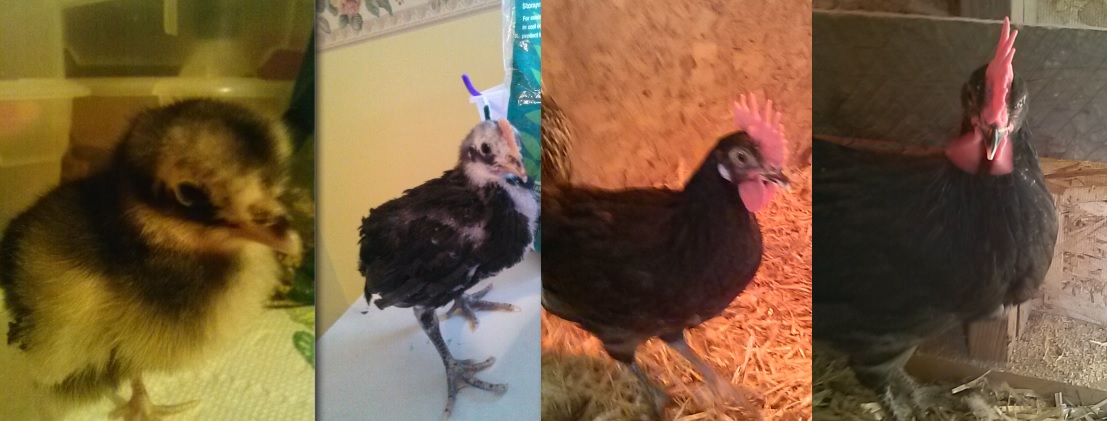
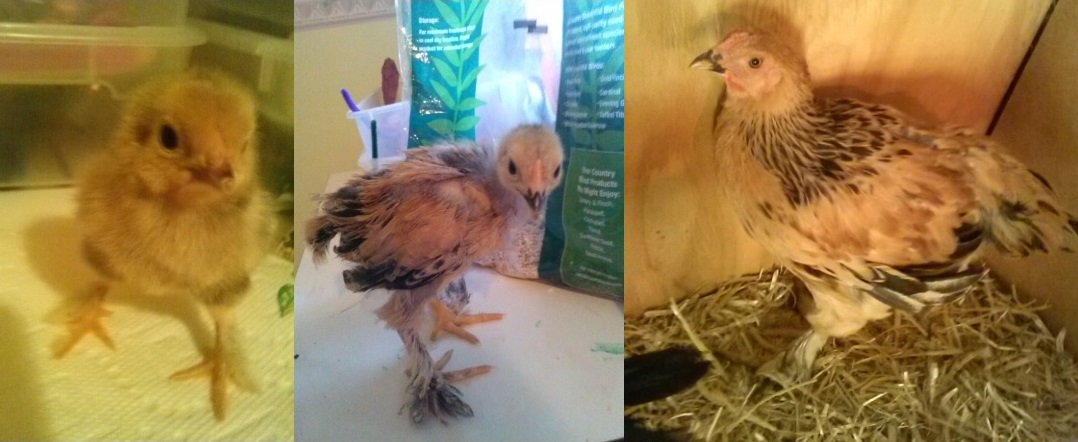
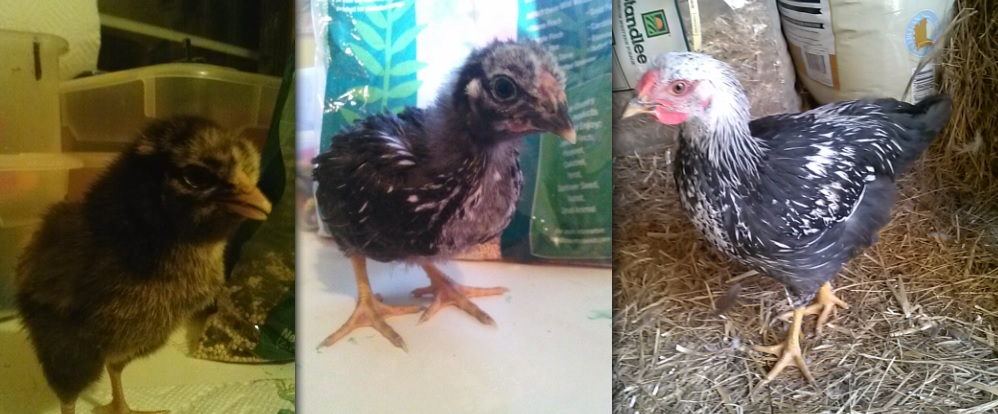
My middle batch of chickens (the older chicks, that I got in the beginning of March) are enjoying their life out in the coop. They have grown a lot and some have changed quite a bit since I first got them – it’s really remarkable how much feather color and patterns can change. There is just not a good way to tell what they will look like as adults when you get them, unless you know the exact breed beforehand. They may change a lot more before they are full grown – they are maybe about half the size of my adult chickens now. I’ve done an update for their previous “update” pics that I posted in late March, so you can see the changes. I have one that was orange as a chick, then looked like they would be pale, and now is a dark brown color. Here are the updated pics to show you how they’ve grown, from 2 days old, to 3 weeks, to 9 weeks:
Here is my little rooster – he keeps trying to crow with my adult rooster – they call back and forth. He sounds pretty funny trying to do his cock-a-doodle-doo -he has a scratchy little crow. His comb is gigantic already, not sure how big it will actually get – hopefully not too big or he’ll be in danger of it getting frostbite in winter.Here’s my little yellow chick that turned into a larger white chicken with black feathers mixed in – still not sure if this one is male or female.Here is my little feathered leg guy (girl?) I like the coloring this one has – caramel colored with black. She looks a lot less like a tiny vulture now than she did at 3 weeks old. My suspicion is that this is a hen – I could be wrong, though.Here’s the orange one I spoke about in the paragraph above – she’s now a dark brown / reddish chicken. She’s very curious and friendly, where the rest are still pretty flighty.This one was showing the speckled feathers at three weeks. Today she did NOT want her picture taken – she tried to hide behind some boards and the other chickens.Here is my little black chick that turned into a white-headed chicken. His (her?) comb is very similar to my adult rooster’s – like a blob thing on their forehead. I’m still not sure the sex of this one.
They are definitely growing quickly. I read that around 10-12 weeks is when their full-on adult feathers come in, and roosters will get their fancy tail feathers around then. By then I should be able to tell for sure if they are hens or roosters.
My newest batch of chicks are now almost 2 weeks old. They’re doing really well. I change their bedding each day (I use paper towels), and when I do, I move everyone to a different box while I clean up their brooder box.
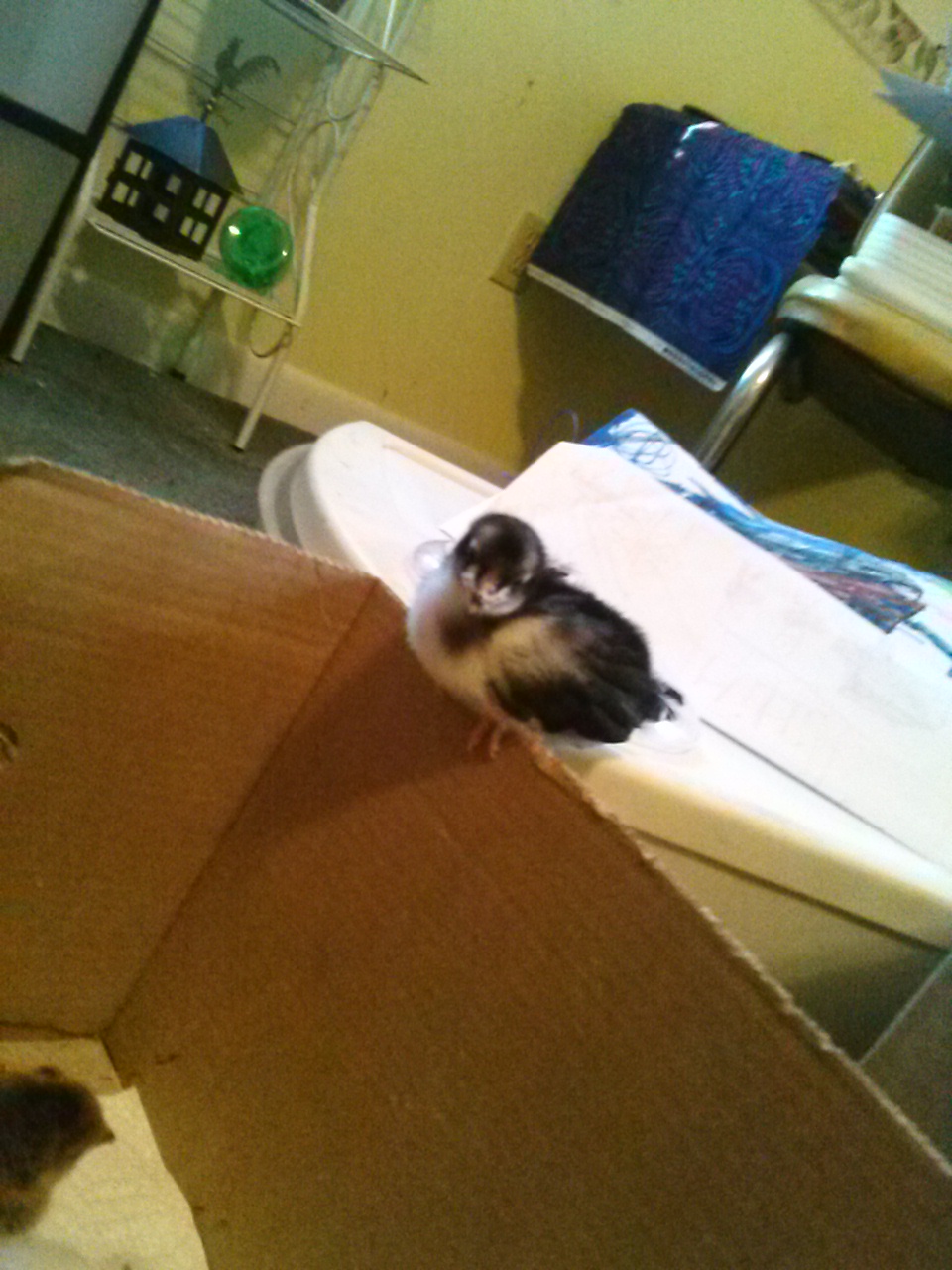
Earlier this week, when they were just over 1 week old, I had put them into the other box to change the bedding, and suddenly one popped up onto the edge of the box and perched. I have never seen a chick this young do this. Granted, I have not been raising chickens that long, but this is my third batch of chicks and I didn’t think it was possible for any to get out this early. It’s a paper-ream box, so it’s a good 10 inches tall. The chick perched on the edge, and then wandered over to a little plastic drawer that is set up next to the boxes, and then to the floor – he wandered around outside the boxes until I was done setting their brooder box back up. I started to put the other chicks back – he saw this and jumped back up onto the drawer, and then into the brooder box. So I didn’t have to put him back at all.
This batch and my last batch were “mixed rare breeds” orders. This means I am still trying to figure out what kinds of chickens I have – it’s fun to try to figure it out. I have been hoping for a Black Sumatra, which is one possible kind they could ship with my order. I was wondering about this one, because I saw pictures of Black Sumatra chicks and they look like little penguins, like this guy. Black & white. But other breeds’ chicks can look very similar, so it’s really hard to tell at this stage. Once I found out this one can hop out of the box, I did some reading and found that other people with Sumatras have had them jump out of the brooder at this age, and as adults they can jump 6 feet. They also like to roost in trees. So it’s very possible that this is a Black Sumatra. Time will tell. Below is a series of pictures of one of his escapes this week – some of the pics are not the best because I was taking them quickly as he moved, trying to get the best picture.
We now have 26 chickens – I received the new babies today! They were replacements for the dead chicks we received in March. The ten we received today are all alive and doing well. Luckily it was a lot warmer this time for their travel, although we did get an inch of snow this morning. A couple of the chicks were a tiny bit sluggish this morning but are now eating and drinking ok, and running around with everyone else.
New chicks in their brooder box
Here are the new chicks:
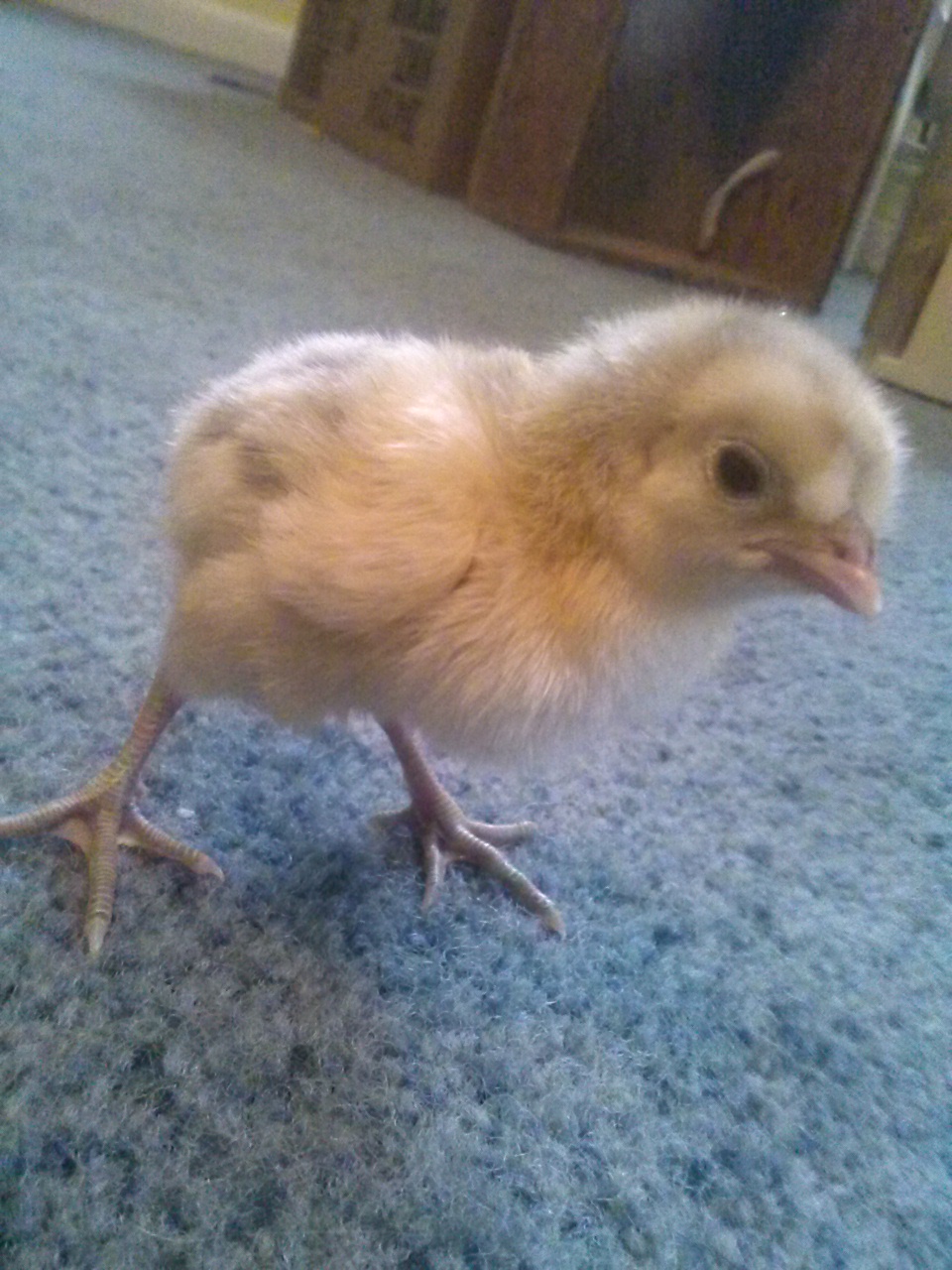
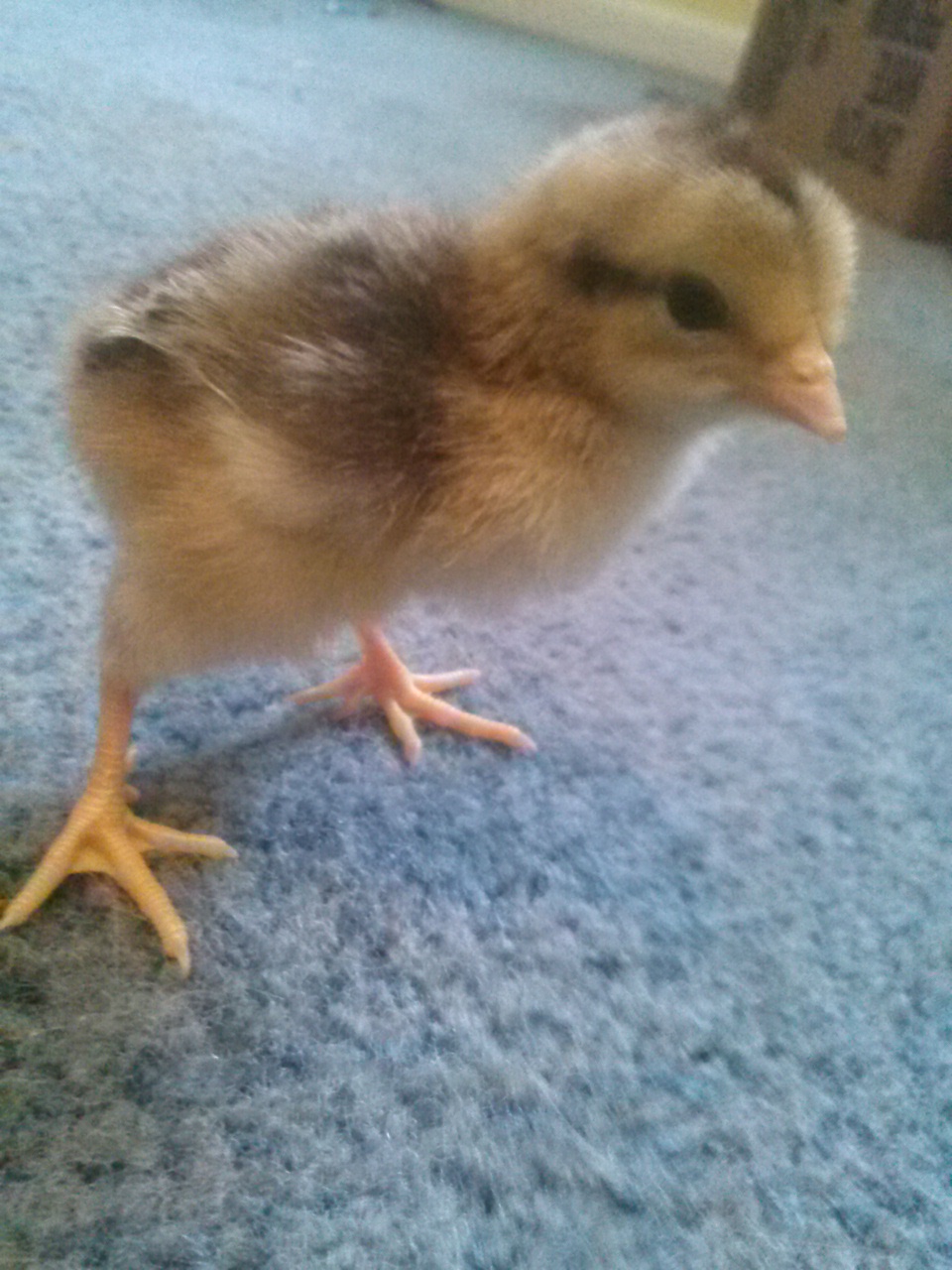
This little one has a top-knot, which means it will have a fluffy feathered head. Most likely some type of Polish chicken.*A little small yellow and gray chick – this one was a little sluggish this morning. He’s a little smaller than everyone else.*This one is a brown and yellow mixtureThis one is pale/white with a darker grayish head. Its fuzz seems a tiny bit longer than most of the others. It also has feathered legs.A little orange chick. This one cheeps a lot and very loudly.These two look like twins, they are both brown with feathered legs, like my older feathered leg one from the last batch.This is a Dorking – you can tell by its toes – it has 5 instead of the typical 4.A close up of the Dorking’s toes.This is a brown stripey chick. It has black stripes down its back.Here’s a little black and silver chick.
I made a brooder box for them out of 3 cardboard boxes that I taped together – smaller than the last brooder, so it will be a lot easier to deal with and to disassemble when they go outside.
They’re all doing great so far.
Here they are all together.
* Update 4/24 – The two chicks that had been sluggish when we first got them died. The little yellow one (2nd single-chick picture, above) was gone by Thursday morning, and then the little Polish chick (the top-knot chick, first single-chick picture above) died Thursday afternoon. I wish I knew what happened, but I think sometimes there is something internal that just doesn’t form correctly. Everyone else is doing well as of tonight (Friday).
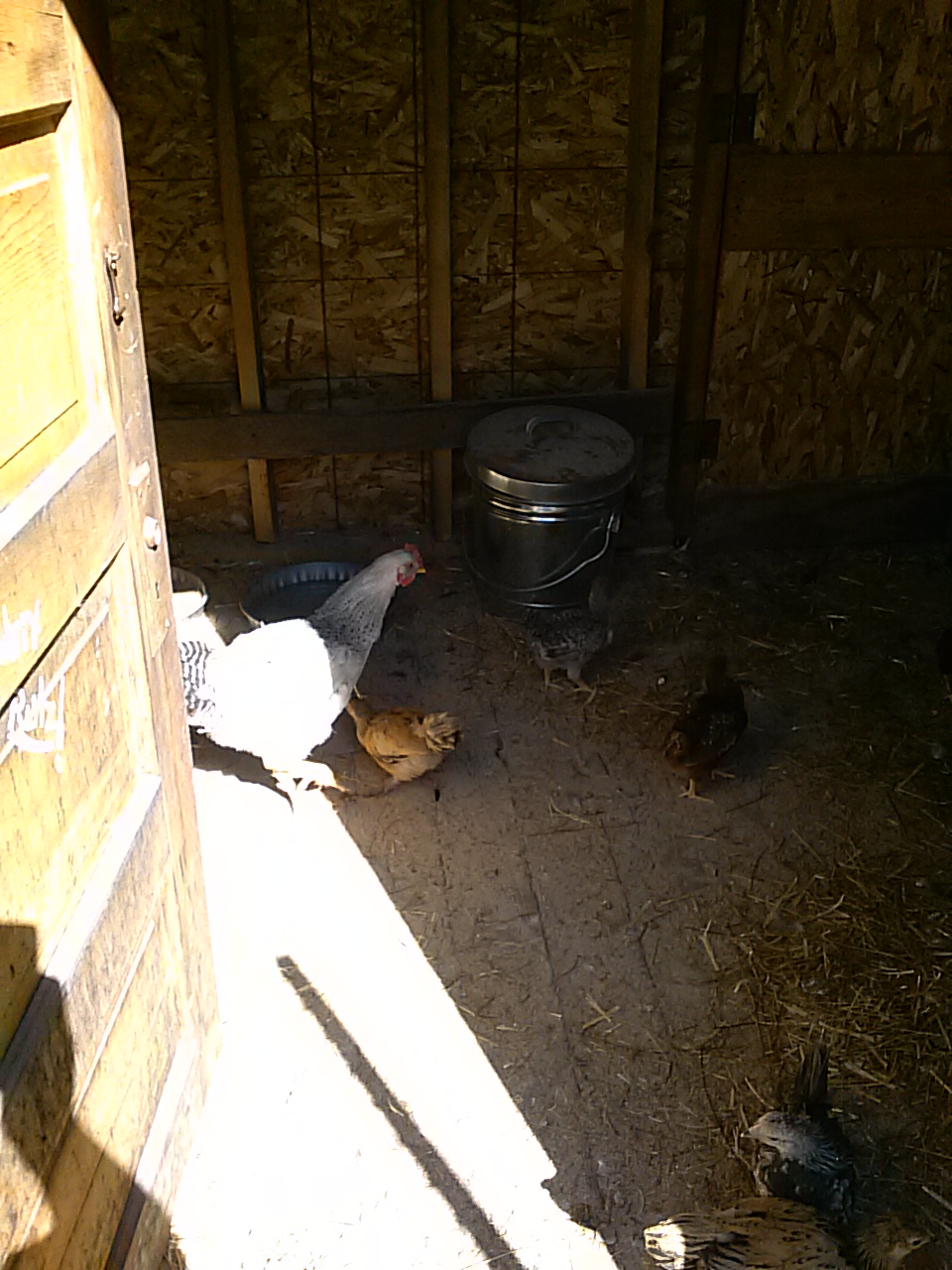
I have been scrambling to get the chicken coop ready to house my baby chicks, and keep them separate from the adult chickens. My goal was to get it done by the end of this weekend – I ended up ahead of schedule, and it was done (enough) by today to put them in. That leaves me tomorrow (Sunday) to start with the yard work I’ve been wanting to get to.
Our chicken house is an old sauna building, split into two rooms. The back room is where our adult birds are. The front room was used for storage until today. When we originally started working on the sauna to get it chicken-ready, we gutted it down to the wall studs, and then lined the whole thing with plastic. We had some nice plastic tarping that I figured would work as a wind break, since the building is so old. The back room was then lined with plywood & particle board to make actual walls. We left the front room unfinished until today.
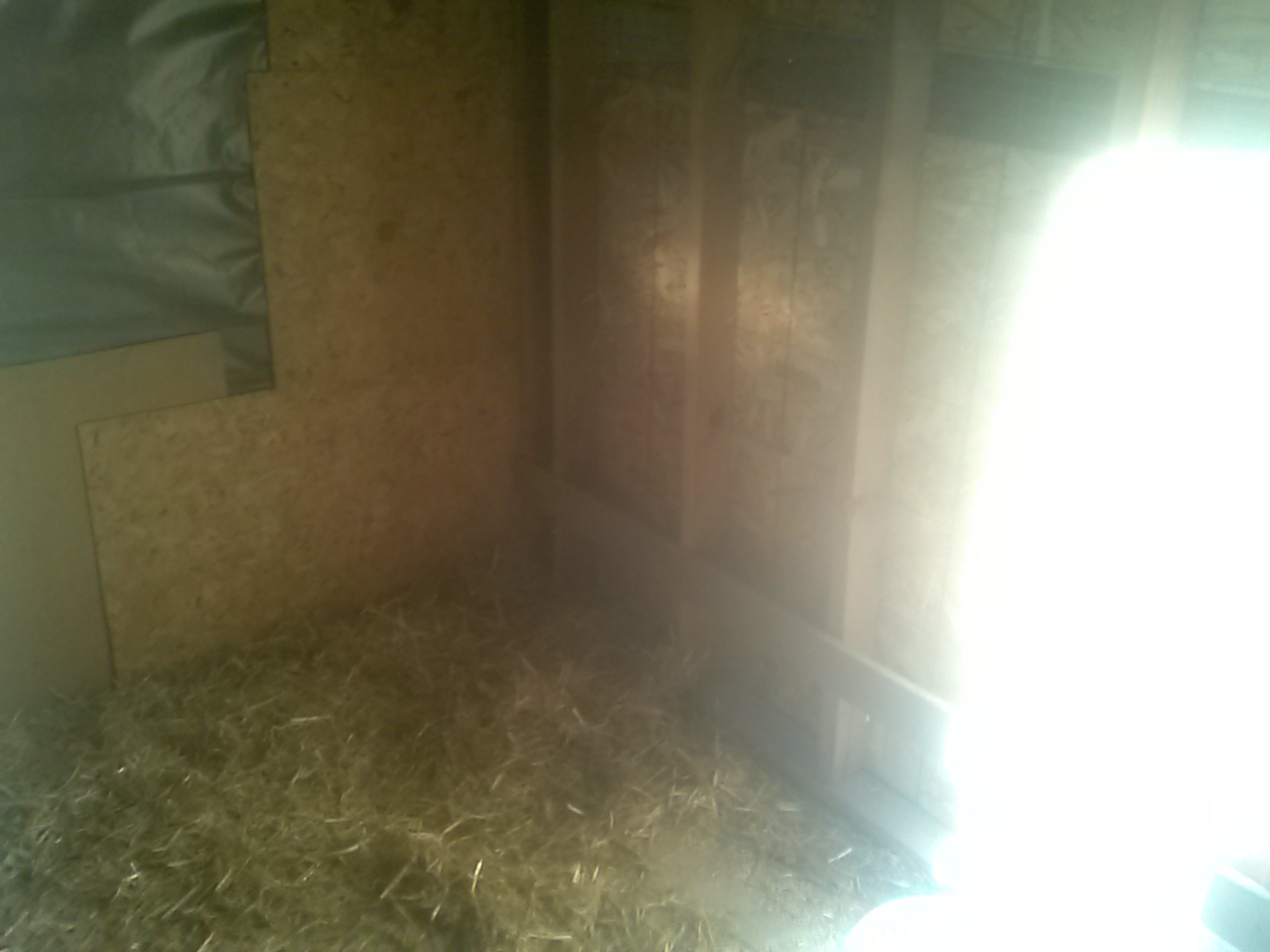
I had a lot of smaller scraps of particle board that my dad had saved for who-knows-what, so that is what I used to wall up the front room. I did most of the walls, but there are a few that still need the upper portions covered. We have some other wood that we will cut to use to fill the spaces that are still left, but for now, it is covered enough for the chicks. We didn’t want them chewing the plastic. Here are some photos – the sun was glaring into the building so the pictures aren’t that great:
Part of the new chicken room, where most of the bedding is.The other side of the new chicken room – the door shown here leads to the back room (the adult chicken’s part).
Our plan once everyone is integrated together is to take down the door that separates the two rooms, create a closet space to the side for their food, and make it one giant chicken palace.
I also built a temporary outside run for the chicks, just a little 8×8 (approximately) with some chicken wire. Here they are enjoying the outside:
The chicks in their new temporary penAnother shot of them in their pen – it was late in the day so the sun was messing up my pictures.
I want to keep them separated from the adults for the next several weeks – I’ve heard 10-12 weeks is a good age to integrate them. But at least they can see each other outside and hear each other inside the coop, so they’ll be somewhat familiar with each other by the time they are old enough. Now I just have to figure out how I’ll integrate the new chicks I’m getting sometime this week. They will be in my spare bedroom like these babies were, but hopefully for not as long.
Today I also ended up giving away one of my adult roosters. I had two, and my neighbor had asked if we had an extra, since he only had hens. I was planning on keeping both of them, but they have recently started fighting. My big orange Buff Orpington had started picking on my Silver Laced Wyandotte, and then they’d fight. They don’t have spurs (I’m not sure if those develop at some point later?) but they have nubs on their legs where spurs would be if they were to grow. I traded my Buff Orpington to the neighbor today for some horse manure; He’s going to drop it off sometime in the next few weeks so I can use it in my compost.
My remaining rooster seems pretty happy since he’s not getting picked on anymore:
My 6 chicks are getting pretty big. They have been hopping up and perching on the edge of their giant box. I am starting to plan out how to move them outside.
They are getting big
They are still too young to go with the adults, but they have their feathers in mostly, and it’s getting warmer now. I have an extra room in the chicken house that I’ve been using for storage – that is now getting cleaned out and we’ll be expanding that this summer to make room for all the newbies. I think we are going to put the babies in there early, possibly next weekend if we can get it ready in time. We’ll have to time the letting-out of everyone to keep the big chickens away from the little chickens, but it’s do-able. I need to also make some kind of small fenced-in area for the babies for awhile, so they have somewhere to go during the day. I need to get them outside soon because they are getting large and trying to escape the box, and they are making the room they are in very dusty, and also we have new baby chicks coming next week – AND, because this guy has started crowing:
The black chick in the middle with the large comb is now crowing.
It’s a very strange sound, because he’s not fully grown. The first time I heard it, last week (when he was only 5 weeks old), I was afraid one of them was hurt – I ran into the room and they were all fine. I sat for a minute to see if they would make the noise again, and he made the noise – it’s not a full on “cock-a-doodle-doo” crow, but more like a hoarse “eee-awww” noise. It’s pretty cute. I’d like to get him outside because we are starting to be able to hear his crow across the house. I hope at least a few of these babies are hens.



















 My tiny u.p. farm